The Moment the Smile Changes
Sam didn’t plan on losing his left premolar. One minute he was savoring brisket at a backyard cookout; the next, a loud crack and a wave of dull pain told him the tooth that had haunted him since childhood soccer mishaps was finally finished. In our treatment room a day later, he asked a question we hear weekly at Clover Smile Studio in Austin:
“Do I go with a bridge because it’s faster, or do I invest in an implant and be done with it?”
His dilemma is universal. You’re staring at two tooth replacement options that promise to fill the gap—yet they solve the problem in completely different ways. The challenge is deciding which set of trade-offs fits your mouth, wallet, and timeline.
A Tale of Two Foundations
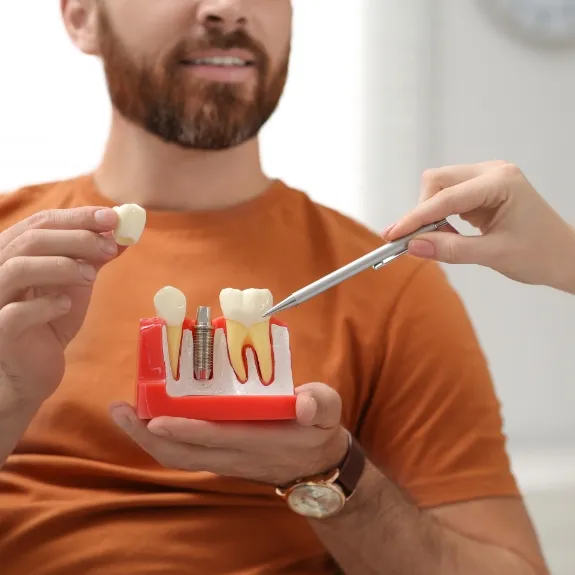
Picture your missing tooth as a vacant lot on a popular street. A dental implant acts like pouring a brand-new concrete footing, then building a little house—root and all—on its own land. By contrast, a fixed bridge borrows the neighbors’ driveways: the two teeth on either side are trimmed down for crowns that hold a suspended “pontic” (false tooth) between them. Both fill the visual gap; the philosophies underneath are worlds apart.
Sam loved the idea of independence—an implant that wouldn’t lean on adjacent teeth—but he also flinched at the three-to-four-month healing arc when summer adventures beckoned. The bridge tempted him with speed: we could prep teeth on Monday and seat the finished piece before his next paycheck cleared.
So which path wins? Let’s peel back the layers in everyday language.

Healing, Feeling, and Everyday Life
Early Days
Implant surgery surprises most patients: local anesthesia, gentle placement, and you walk out clutching an ice pack—sore, but not incapacitated. For Sam that would mean two days of Netflix and soft tacos before boredom, not pain, drove him off the couch.
Bridge prep, meanwhile, feels more like an extended crown appointment. Your gums may grumble a bit where they were retracted for impressions, and the temp can feel slightly bulkier—think a pebble in the shoe until you adapt.
Months and Years
Sam’s biggest worry was maintenance. With a bridge, flossing requires a little threader to snake under the pontic; skip it, and plaque parties where you can’t see. An implant, once integrated, behaves like a stand-alone tooth: brush, floss, repeat. Yet implants ask for patience: three to four months of bone-to-titanium fusion (a process we call osseointegration) before the final crown.
The Bone Story No One Talks About
Chewing does more than pulverize nachos; it signals your jawbone to stay robust. Remove a natural root and the bone slowly retreats, reshaping your face in subtle ways over the years. The titanium post of an implant keeps that stimulation alive, preserving bone height and width. Bridges, because they hover above the gum, can’t offer that workout. Over a decade, Sam’s jaw might thin enough that a future implant—or even a denture clasp—would need grafting.
Dollars Today vs. Dollars Tomorrow
Sam’s insurance would pay almost half the cost of a bridge but only the crown portion of an implant, leaving surgery out-of-pocket. On paper, the bridge looked friendly. Yet bridges typically last seven to ten years before decay or wear demands a remake. Factor in possible root canals on crowned teeth and the sum often covertly eclipses the one-time implant fee.
He did the math like this:
- Bridge → Lower entry cost + future replacements + higher cavity risk
- Implant → Higher entry cost + long lifespan + bone savings
Sam’s aha-moment came when he realized the implant cost equaled two smartphone upgrades spread over twenty years. Perspective reshaped the “expensive” label into “long-term value.”

The Confidence Quotient
Cosmetics matter—because confidence matters. An implant emerges from the gum like a natural tooth; light hits it believably in selfies. Bridges can look fantastic too, yet the gum beneath the pontic sometimes dips over time, creating a tiny shadow gap. Sam’s social-media-savvy side voted for the chameleon effect of an implant.
What We Tell Our Patients in Austin
Whenever someone sits where Sam did, we run through three touchstones:
- Health First — Do meds, smoking, or medical history hinder bone healing?
- Tooth Neighbors — Are they pristine or already begging for crowns?
- Life Calendar & Wallet — Weddings, semesters abroad, insurance cycles.
If two out of three favor the implant, that’s usually the better call. But sometimes speed or existing crown needs tilt the scales toward a bridge, and that’s perfectly valid.
Sam’s Decision—And How It Played Out
Sam chose the implant. He scheduled surgery right after finals, binged docuseries with an ice pack, and by autumn, when campus life kicked up, his permanent crown was locked in. One year later, he confided that he no longer thought about that tooth—“It’s just… my tooth.” And that’s perhaps the highest praise any dental work can earn.
So, is an implant better than a bridge?
Usually, yes: an implant keeps your jawbone strong and tends to last decades, while a bridge fills the space faster but may compromise the neighboring teeth and need replacement in 7–10 years.